The Diamond Was Never Just a Stone:
How an Industry Manufactured Rarity
For more than a century, the diamond industry sold us something
larger than carbon. It sold rarity, permanence and the idea that
love could be measured in carats. Lab-grown diamonds are forcing
us to ask how much of that value belonged to the stone — and how
much belonged to the story.
A diamond seems like the perfect luxury object. It is small, durable,
visually spectacular and surrounded by a language of rarity. We are
taught to understand it through carat, cut, clarity and colour, but
behind those measurements sits another, less visible quality: belief.
For generations, consumers have been taught that a diamond is valuable
because nature made very few of them and because acquiring one requires
access to something exceptional. Yet the modern diamond market was never
shaped by geology alone. Supply was organised, distribution was controlled,
advertising attached diamonds to marriage and permanence, and an ordinary
mineral became one of the most emotionally loaded luxury products in the
world.
Now technology has complicated that story. A laboratory can produce a
diamond with essentially the same chemical composition, crystal structure,
optical properties and physical properties as one extracted from the
earth. The difference is no longer simply what the object is. It is where
it came from, how long it took to form and what we are willing to believe
that origin is worth.
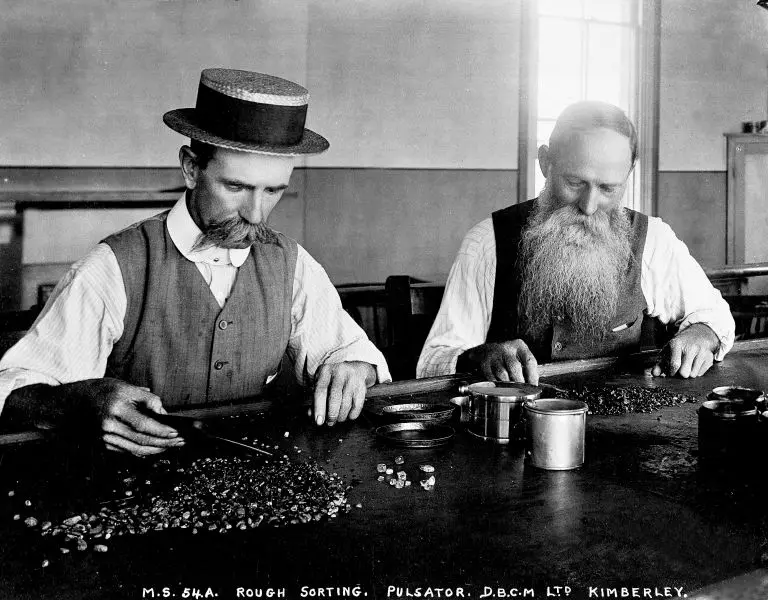
Rough Diamonds · Historical Diamond Trade
The Old System
Rarity was never purely geological.
For much of the twentieth century, De Beers occupied an extraordinary
position in the diamond market. It did not simply own mines. Through
its own production, joint ventures, purchasing agreements and its
Central Selling Organisation, the company controlled the route through
which much of the world's rough-diamond supply reached buyers.
The European Commission later described De Beers as having controlled
more than 80 percent of worldwide rough-diamond supply for much of the
twentieth century. GIA's history of rough-diamond distribution similarly
estimates that De Beers commanded roughly 75 to 80 percent of world
rough-diamond sales through much of the last century.
That distinction matters. De Beers did not need to own 80 percent of
every mine in order to exert enormous influence over the market.
Control over distribution meant influence over how much rough entered
the market, who could purchase it and how the industry's supply was
organised.
Selling Permanence
Then the stone became a promise.
Controlling supply was only part of the equation. Diamonds also had
to mean something.
In 1947, copywriter Frances Gerety wrote four words for the De Beers
account at advertising agency N.W. Ayer: “A Diamond Is Forever.”
The campaign connected the physical durability of a diamond with
romantic permanence and helped reinforce the diamond engagement ring
as a cultural expectation.
It was an extraordinary piece of luxury storytelling because the
product became inseparable from the emotion attached to it. A diamond
was no longer merely purchased because it sparkled. It represented
commitment, status, adulthood and permanence.
The industry had transformed carbon into symbolism. That may ultimately
have been its most valuable achievement.
80%+
For much of the twentieth century, De Beers controlled more than
80 percent of worldwide rough-diamond supply — not by owning every
mine, but through a powerful network of production, purchasing and
distribution.
GIA · Laboratory-Grown Diamond Reference
The Disruption
What happens when we learn to make the stone?
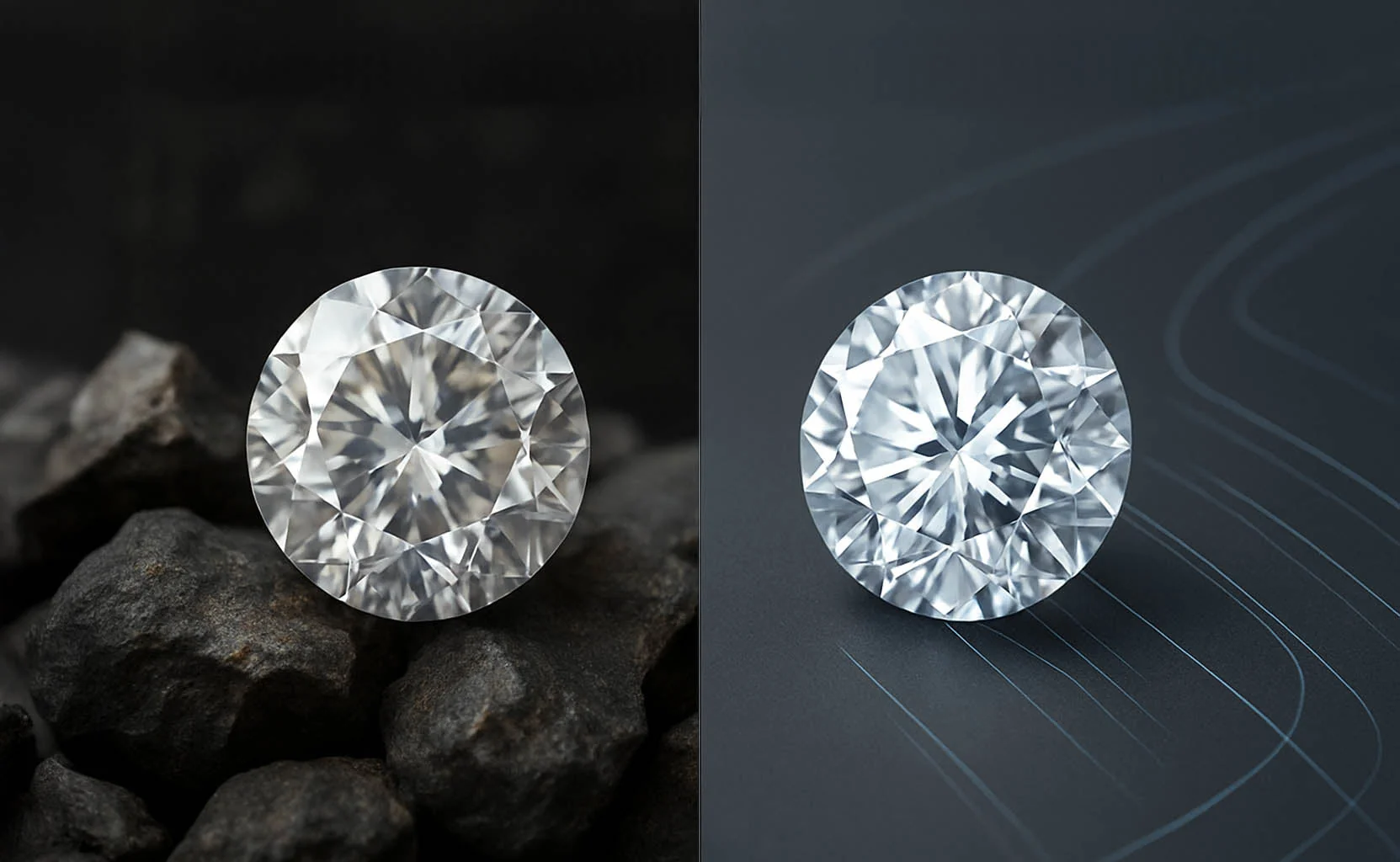
A laboratory-grown diamond is not cubic zirconia and it is not
moissanite. According to the Gemological Institute of America,
laboratory-grown diamonds have essentially the same chemical
composition, crystal structure, optical properties and physical
properties as natural diamonds.
Their histories, however, could hardly be more different. Natural
diamonds formed deep within the earth over immense geological periods.
Laboratory diamonds can be grown using high-pressure, high-temperature
technology or chemical vapour deposition. Modern production can create
gem-quality stones in periods measured in days or weeks rather than
geological time.
Suddenly, one of luxury's oldest equations becomes unstable. If two
stones can look effectively identical to the unaided eye, but one can
be produced repeatedly, what exactly is the consumer paying for when
choosing the other?
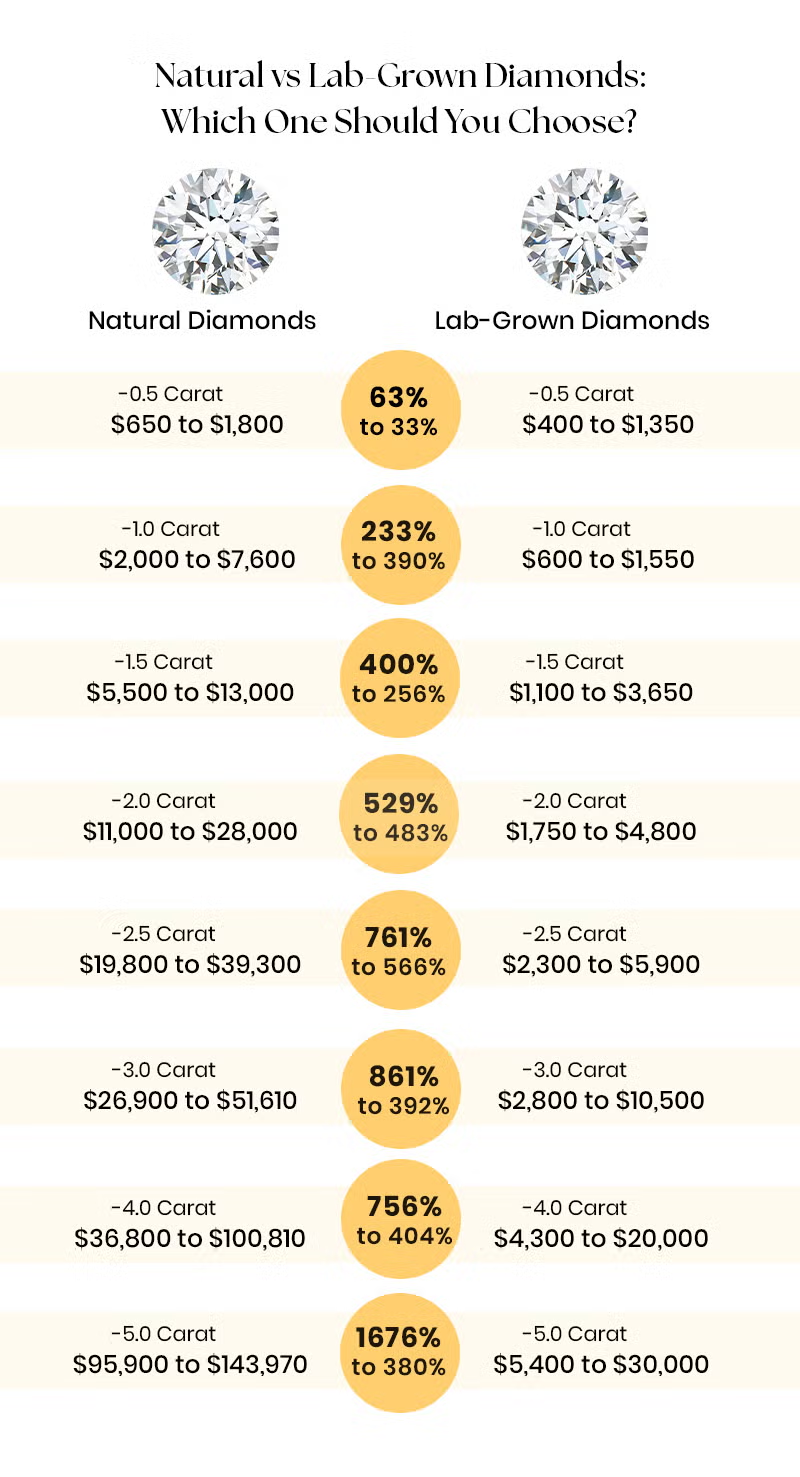
Diamond Price Comparison · Digital Market
From Counter to Screen
The buying experience changed too.
The traditional diamond purchase depended partly on information
asymmetry. The jeweller understood the stone; the consumer relied on
expertise, certification and trust. Today, that relationship is
increasingly digital.
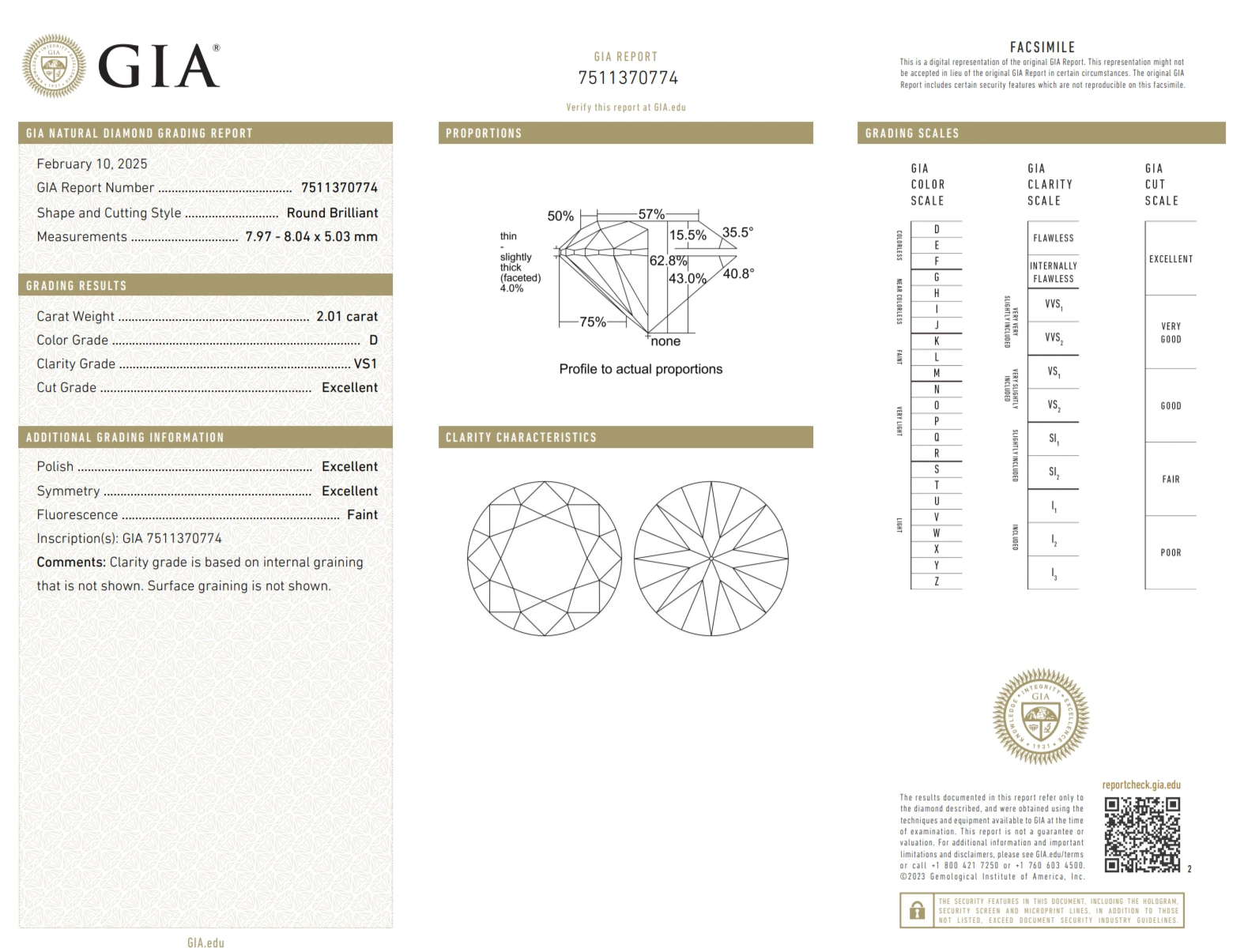
Consumers can sit at home and filter enormous inventories by carat,
cut, colour, clarity, certification and price. Digital grading reports
can be accessed instantly. Stones can be compared side by side before
the buyer ever enters a boutique.
McKinsey has identified e-commerce as an increasingly important channel
for fine jewellery, particularly among younger consumers. The effect is
not simply convenience. Digital comparison makes pricing more visible.
A product once surrounded by mystery begins to behave more like a
transparent marketplace.
The diamond is still emotional. The process of buying one is becoming
considerably less mysterious.
A New Consumer
Bigger stone. Smaller mythology.
The most important change may not be technological at all. It may be
generational.
The Knot's research found that lab-grown centre stones represented
52 percent of engagement rings among its 2024 respondents. Its 2026
Real Weddings Study, covering U.S. couples married in 2025, put that
figure at 61 percent. In only a few years, what had been positioned as
an alternative had moved into the mainstream of its surveyed market.
The same research found another revealing shift: couples were buying
larger stones while average engagement-ring spending fell. Among its
2025 respondents, the average lab-grown centre stone was two carats,
compared with 1.6 carats for natural stones.
This does not necessarily mean younger consumers no longer care about
heritage or savoir-faire. It suggests something more complicated.
They may not automatically accept heritage as sufficient justification
for price.
Design, scale, personal meaning, transparency and accessibility can
compete with provenance. The story still matters. The consumer is
simply becoming more willing to choose which story deserves a premium.
90%
De Beers said wholesale lab-grown diamond prices fell 90 percent
between the launch of Lightbox in 2018 and its decision to close
the jewellery brand in 2025.
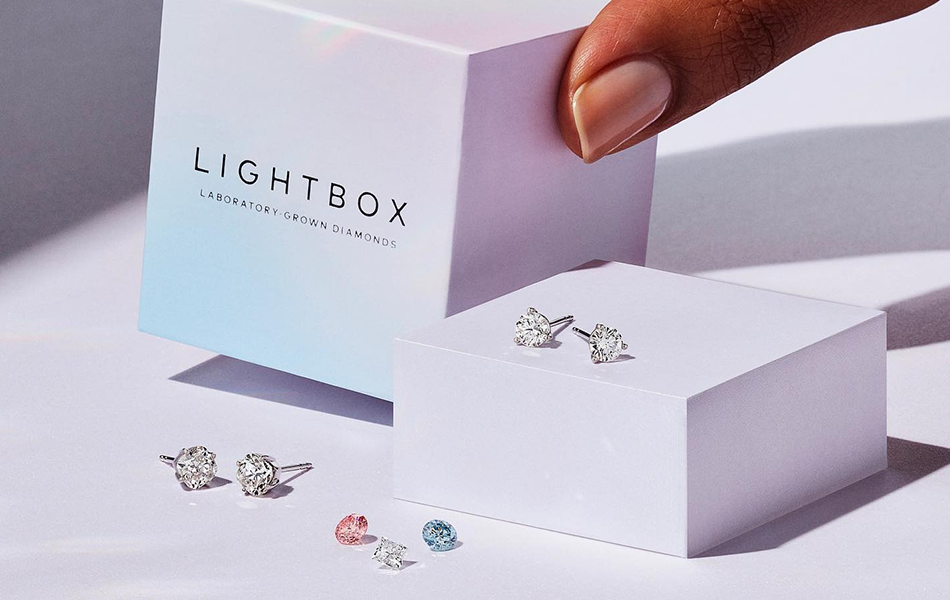
Lightbox · De Beers Group
Mass Production
Accessibility has a price of its own.
The success of laboratory-grown diamonds created the same problem
that confronts almost every product that becomes easier to manufacture:
abundance pushes against value.
In 2018, De Beers entered lab-grown jewellery itself through Lightbox,
initially pricing its stones on a simple per-carat basis. Seven years
later, the company announced that it intended to close the business.
De Beers said wholesale lab-grown diamond prices had fallen 90 percent
since Lightbox launched, as production expanded and competition
intensified.
That collapse exposes the paradox at the centre of the lab-grown
revolution. Accessibility is precisely what makes the product
attractive to consumers, but accessibility also removes one of the
foundations on which traditional luxury has historically been built:
scarcity.
When almost anyone can produce more of the material, value must migrate
somewhere else — toward design, brand, craftsmanship, provenance or
emotion.
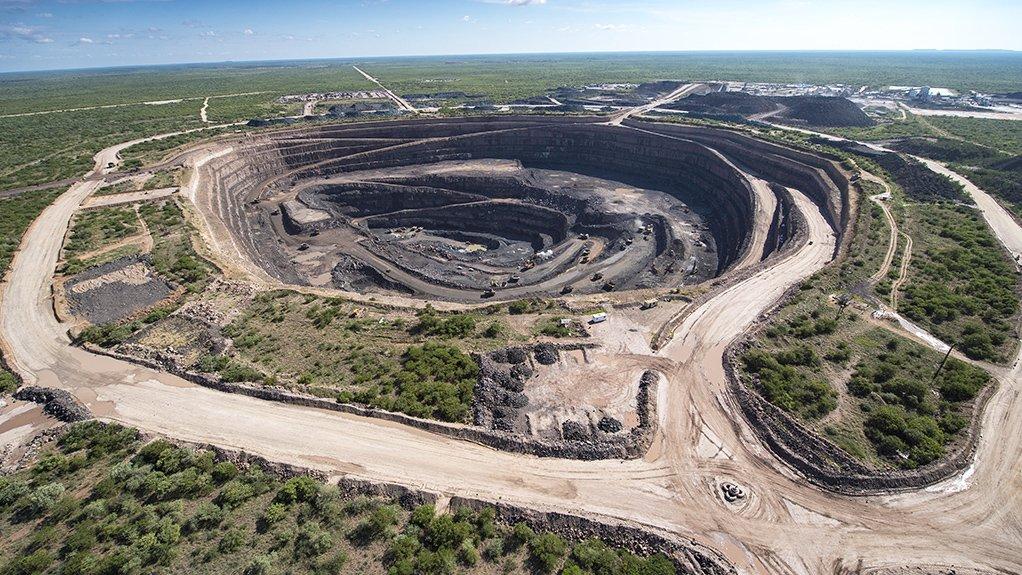
Botswana · Diamond Mining
The Ethics Problem
Neither side gets an easy moral victory.
Lab-grown diamonds are frequently presented as the ethical answer to
mining, and the appeal is understandable. Mining industries can carry
serious environmental and human-rights risks, making traceability and
responsible sourcing increasingly important to consumers.
But “grown in a laboratory” should not automatically be read as
“sustainable.” Diamond growth requires significant energy. The
environmental impact of laboratory-grown diamonds can vary considerably
depending on the technology used, the energy source powering production
and the manufacturing practices behind the stone.
Mass production also introduces a different question. If laboratory
diamonds are manufactured at enormous scale and sold at continuously
declining prices, they begin to participate in the same cycle of
abundance and consumption that luxury increasingly claims it wants
to move beyond.
The future of ethical jewellery may therefore depend less on a simple
choice between “mined” and “lab-grown” and more on transparency:
where a stone came from, how it was produced, what energy was used,
who benefited from its production and how honestly those facts are
communicated.
After Rarity
So what is a diamond actually worth?
Perhaps that has always been the wrong question.
The history of diamonds demonstrates that luxury value has never existed
entirely inside the object. De Beers understood this exceptionally well.
Supply mattered, but so did distribution. Geology mattered, but so did
advertising. A stone became powerful because an industry constructed an
entire cultural language around it.
Lab-grown diamonds have not destroyed that language. They have exposed
how it works.
If the physical characteristics of a diamond can be reproduced while its
price falls dramatically, then natural-diamond producers can no longer
rely on sparkle alone. They must sell geological time, provenance,
traceability and rarity. Lab-grown producers face the opposite problem:
if their stones become increasingly abundant, they must build value
through design, branding, craftsmanship and meaning.
Both sides are therefore moving toward the same uncomfortable truth.
Carbon was never enough.
The diamond industry spent a century teaching us that the stone
was valuable because it was rare. Lab-grown diamonds are forcing
it to confront a different possibility: perhaps the rarest thing
was never the diamond. It was the story surrounding it.
Sources & Further Reading
European Commission —
De Beers' historical position in the worldwide rough-diamond market
and the role of the Diamond Trading Company.
Gemological Institute of America —
historical changes in rough-diamond pricing and distribution,
including De Beers' position in the twentieth-century market.
Gemological Institute of America —
research on the differences and similarities between natural and
laboratory-grown diamonds.
Gemological Institute of America —
HPHT and CVD diamond-growth processes and identification.
Federal Trade Commission —
Jewelry Guides and disclosure standards applying to laboratory-grown
and mined diamonds.
De Beers Group —
announcement of the intended closure of Lightbox in May 2025,
including its reported decline in wholesale lab-grown diamond prices
since 2018.
McKinsey & Company —
analysis of the diamond industry's changing economics, consumer
behaviour, lab-grown competition, traceability and digital retail.
The Knot —
engagement-ring and Real Weddings research covering lab-grown diamond
adoption, centre-stone size and purchasing behaviour among U.S.
respondents.
Auburn University —
historical research on the creation and development of the diamond
engagement-ring tradition in the United States.